
Transcranial Doppler (TCD) ultrasonography
What is Transcranial Doppler (TCD)?
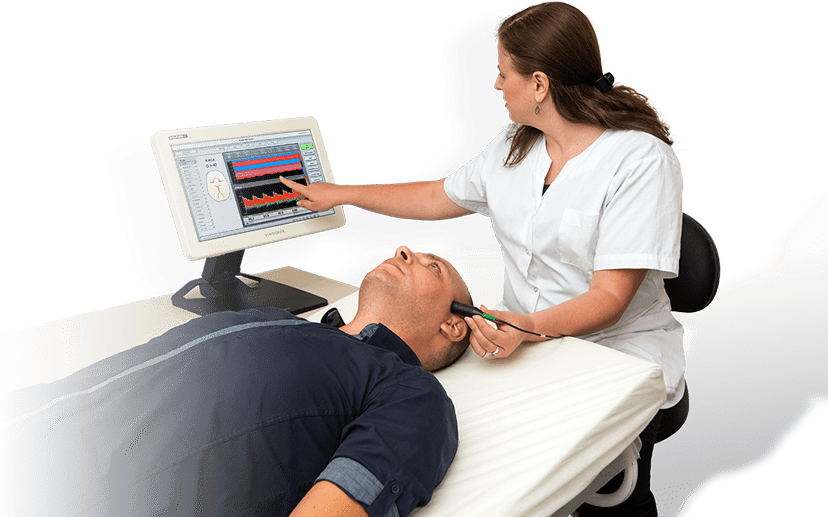
Transcranial Doppler (TCD) is a highly specialized, non-invasive ultrasound technique used to measure the velocity and direction of blood flow within the major arteries deep inside the brain. Unlike standard extracranial Doppler ultrasound (which assesses the carotid and vertebral arteries in the neck), TCD utilizes low-frequency sound waves (typically 2 MHz) capable of penetrating the skull bone to evaluate the intracranial hemodynamics.
This dynamic assessment allows neurosurgeons and neurologists to evaluate the Circle of Willis, detect intracranial stenosis, monitor for life-threatening vasospasms, and evaluate the brain's collateral blood supply in real-time.
Clinical Indications for TCD
TCD is an essential tool in modern neuro-diagnostics. Its primary clinical applications include:
- Vasospasm Detection Post-SAH: Monitoring patients daily for cerebral vasospasm following an aneurysmal Subarachnoid Hemorrhage (SAH). TCD can detect dangerous narrowing of the arteries before clinical symptoms appear.
- Intracranial Arterial Stenosis: Identifying severe narrowing or occlusion within the Middle Cerebral Artery (MCA), Anterior Cerebral Artery (ACA), or Posterior Cerebral Artery (PCA), which strongly correlates with ischemic stroke risk.
- Patent Foramen Ovale (PFO) & Microemboli Detection: Using a specialized "bubble study" with agitated saline, TCD can detect paradoxical right-to-left cardiac shunts, which are a common cause of cryptogenic strokes. TCD can also continuously monitor the brain for silent microemboli.
- Brain Death Evaluation: TCD is a recognized ancillary test in establishing brain death, demonstrating characteristic flow patterns such as oscillating flow or isolated systolic spikes indicating the cessation of cerebral circulation.
- Intraoperative Monitoring: TCD is frequently utilized during carotid endarterectomy (CEA) or cardiovascular surgeries to monitor cerebral perfusion and detect embolic events in real-time.
- Sickle Cell Disease: Screening children (ages 2–16) to assess stroke risk and guide transfusion therapy.
- Traumatic Brain Injury (TBI) and ICU Monitoring: Evaluating cerebral autoregulation and intracranial pressure dynamics.
Need Expert Advice on Your Condition?
Get a personalized video breakdown and treatment plan from our senior neurosurgeons using your MRI/CT scans.
👉 Request MRI ReviewThe TCD Procedure and Acoustic Windows
Because the human skull absorbs and blocks high-frequency ultrasound waves, TCD must be performed through naturally thinner areas of the cranium, known as acoustic windows. The procedure is painless and typically takes 30 to 45 minutes.
The neuro-sonographer applies a water-based gel and utilizes three primary acoustic windows:
- The Transtemporal Window: Located on the side of the head, just above the cheekbone (zygomatic arch) and in front of the ear. This is the primary window used to assess the MCA, ACA, PCA, and the terminal portion of the Internal Carotid Artery (ICA).
- The Transorbital Window: The transducer is placed gently over the closed eyelid with significantly reduced acoustic power. This window evaluates the Ophthalmic Artery and the Carotid Siphon.
- The Transforaminal (Suboccipital) Window: The transducer is placed at the base of the skull, directing the beam through the foramen magnum. This evaluates the posterior circulation, including the intracranial Vertebral Arteries (VA) and the Basilar Artery (BA).
Interpretation of Results
TCD does not produce a visual "picture" of the blood vessel like an MRI or CT scan. Instead, it produces a spectral waveform and calculates the Mean Flow Velocity (MFV) and the Pulsatility Index (PI).
- Abnormally High Velocities: Blood flow accelerates as it passes through a narrowed segment. Markedly elevated velocities (e.g., MFV >120 cm/s in the MCA) strongly suggest severe stenosis or post-hemorrhagic vasospasm.
- Abnormally Low Velocities: May indicate a proximal occlusion (e.g., a blocked carotid artery in the neck resulting in diminished flow arriving at the brain) or severely increased intracranial pressure.
- Altered Pulsatility: A high Pulsatility Index (PI) indicates high downstream resistance, which can be an early sign of microvascular disease or elevated intracranial pressure.
Advantages and Limitations
Advantages:
- Non-invasive, safe, and radiation-free — can be repeated as often as needed.
- Bedside and real-time monitoring, ideal for ICU patients.
- Portable, relatively inexpensive, and provides immediate physiological information.
- Excellent for continuous monitoring of vasospasm, emboli, and intraoperative events.
Limitations:
- Highly operator-dependent; results rely on the experience of the neuro-sonographer.
- Inadequate acoustic windows in 10–15% of patients (especially older individuals or those with thick skulls).
- Does not provide anatomical images — best used in combination with CTA, MRA, or conventional angiography.
- Limited visualization of distal or very small vessels.
Patient Preparation
No special preparation is usually required for a TCD examination. Patients can eat, drink, and take medications normally. It is recommended to:
- Remove contact lenses (for the transorbital window).
- Avoid heavy makeup or creams on the face and neck.
- Inform the doctor about any medications that might affect blood flow (e.g., vasodilators).
The test is painless, does not use contrast agents or radiation, and is safe for children, pregnant women, and patients with pacemakers.
References
- Alexandrov AV, Sloan MA, Wong KS, et al. Practice standards for transcranial Doppler ultrasound: part I--test performance. J Neuroimaging. 2007;17(1):11-18.
- Purkayastha S, Sorond F. Transcranial Doppler ultrasound: technique and application. Semin Neurol. 2012;32(5):411-420.
- Sloan MA, Alexandrov AV, Tegeler CH, et al. Assessment: transcranial Doppler ultrasonography: report of the Therapeutics and Technology Assessment Subcommittee of the American Academy of Neurology. Neurology. 2004;62(9):1468-1481.
- Additional sources: Cleveland Clinic, Barrow Neurological Institute, and recent reviews on TCD applications (2024–2026).
See also
- Craniocervical vessels Doppler ultrasonography (UZDG)
- Transcranial Doppler (TCD) ultrasonography
- Electroencephalography (EEG)
- Electromyography (EMG) and Electroneurography (ENG)
- Evoked Potentials (SSEP, MEP, VEP, BAEP)
- Vestibular Testing and Videonystagmography (VNG)
- Intraoperative Neuromonitoring (IONM)
- Lumbar puncture (LP)
Need Expert Advice on Your Condition?
Get a personalized video breakdown and treatment plan from our senior neurosurgeons using your MRI/CT scans.
👉 Request MRI Review