
Evoked Potentials (SSEP, MEP, VEP, BAEP)
Understanding Evoked Potentials (EP)
Evoked Potentials (EP) are specialized functional diagnostic tests used to measure the electrical activity of the brain and spinal cord in response to specific sensory or motor stimuli. While an EEG measures the brain's spontaneous electrical activity, EP testing records how quickly and completely nerve signals travel along specific neural pathways.
By measuring the "latency" (the time it takes for a signal to arrive) and the "amplitude" (the strength of the signal), neurosurgeons and neurologists can pinpoint exactly where a nerve pathway is damaged, compressed, or demyelinated—even before abnormalities appear on an MRI scan.
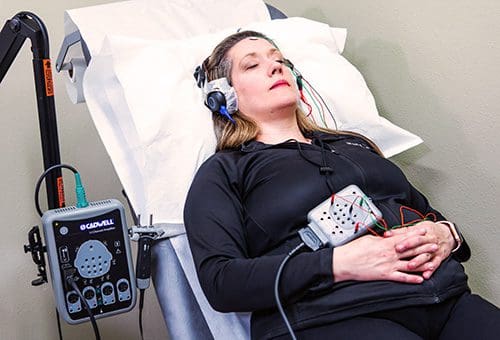
Types of Evoked Potentials
There are four primary modalities of EP testing, each targeting a specific neurological pathway:
1. Somatosensory Evoked Potentials (SSEP)
SSEPs evaluate the sensory pathways from the peripheral nerves in the arms and legs, through the spinal cord, and up to the sensory cortex of the brain. Mild, painless electrical pulses are applied to a nerve at the wrist or ankle, and electrodes on the scalp and spine record the signal's journey. SSEPs are critical for diagnosing spinal cord compression, spinal stenosis, and peripheral neuropathies.
2. Motor Evoked Potentials (MEP)
MEPs evaluate the descending motor pathways from the brain's motor cortex down to the muscles in the limbs. A specialized magnetic or electrical pulse is safely applied to the motor cortex (Transcranial Magnetic Stimulation - TMS), and the resulting muscle contraction is recorded via electrodes. MEPs assess the integrity of the spinal cord's motor tracts and are highly valuable in diagnosing myelopathy or motor neuron diseases.
3. Visual Evoked Potentials (VEP)
VEPs assess the visual pathways from the retina, through the optic nerve, to the visual cortex in the occipital lobe. The patient watches a screen displaying a flashing checkerboard pattern while electrodes on the back of the head record the brain's response. VEPs are highly sensitive in detecting optic neuritis, a common early sign of Multiple Sclerosis (MS), as well as optic nerve compression from pituitary adenomas.
4. Brainstem Auditory Evoked Potentials (BAEP)
BAEPs measure the auditory nerve pathways from the inner ear through the brainstem. The patient wears headphones delivering a series of clicking sounds, and scalp electrodes record the brainstem's processing speed. BAEPs are used to diagnose acoustic neuromas (vestibular schwannomas), brainstem lesions, and hearing loss origins.
Need Expert Advice on Your Condition?
Get a personalized video breakdown and treatment plan from our senior neurosurgeons using your MRI/CT scans.
👉 Request MRI ReviewClinical Indications for EP Testing
Evoked potential studies are considered a gold-standard diagnostic adjunct in several complex neurological scenarios:
- Spinal Cord Compression: To determine if a herniated disc, tumor, or severe spinal stenosis is actively damaging the functional transmission of the spinal cord (Myelopathy).
- Demyelinating Diseases: VEP and SSEP are highly sensitive in detecting subclinical demyelination (loss of nerve insulation), making them essential in the diagnosis of Multiple Sclerosis.
- Pre-Surgical Baseline: EPs are often performed before complex spine or brain tumor surgeries to establish a baseline of nerve function. This data is then utilized during surgery via Intraoperative Neuromonitoring (IONM) to ensure the surgical team does not inadvertently damage neural pathways.
- Peripheral Nerve Injuries: Differentiating between central spinal cord lesions and peripheral nerve entrapments (like severe carpal tunnel or sciatica).
The EP procedure is safe, entirely non-invasive, and relies solely on the placement of surface electrodes on the skin and scalp. Results provide indispensable functional data that structural imaging (MRI/CT) cannot reveal on its own.
References
- Nuwer MR, Aminoff M, Desmedt J, et al. IFCN recommended standards for short latency somatosensory evoked potentials. Report of an IFCN committee. Electroencephalogr Clin Neurophysiol. 1994;91(1):6-11.
- MacDonald DB. Intraoperative motor evoked potential monitoring: overview and update. J Clin Monit Comput. 2006;20(5):347-377.
- Walsh P, Kane N, Butler S. The clinical role of evoked potentials. J Neurol Neurosurg Psychiatry. 2005;76 Suppl 2(Suppl 2):ii16-ii22.
See also
- Craniocervical vessels Doppler ultrasonography (UZDG)
- Transcranial Doppler (TCD) ultrasonography
- Electroencephalography (EEG)
- Electromyography (EMG) and Electroneurography (ENG)
- Evoked Potentials (SSEP, MEP, VEP, BAEP)
- Vestibular Testing and Videonystagmography (VNG)
- Intraoperative Neuromonitoring (IONM)
- Lumbar puncture (LP)
Need Expert Advice on Your Condition?
Get a personalized video breakdown and treatment plan from our senior neurosurgeons using your MRI/CT scans.
👉 Request MRI Review