
Aphemia
Definition and Historical Context
Aphemia is a neurological speech disorder characterized by a severe impairment in motor speech production, while the comprehension of both spoken and written language remains remarkably intact. Patients with aphemia know exactly what they want to say and can often write it down flawlessly, but they struggle to physically articulate the words.
Historically, the term "aphemia" was originally coined by the renowned French physician Paul Broca in 1861 to describe the profound language deficit that was later renamed "Broca’s aphasia." Today, however, the term has evolved in clinical neurology and is specifically used to describe a much narrower, purely motor speech deficit rather than a true linguistic aphasia.
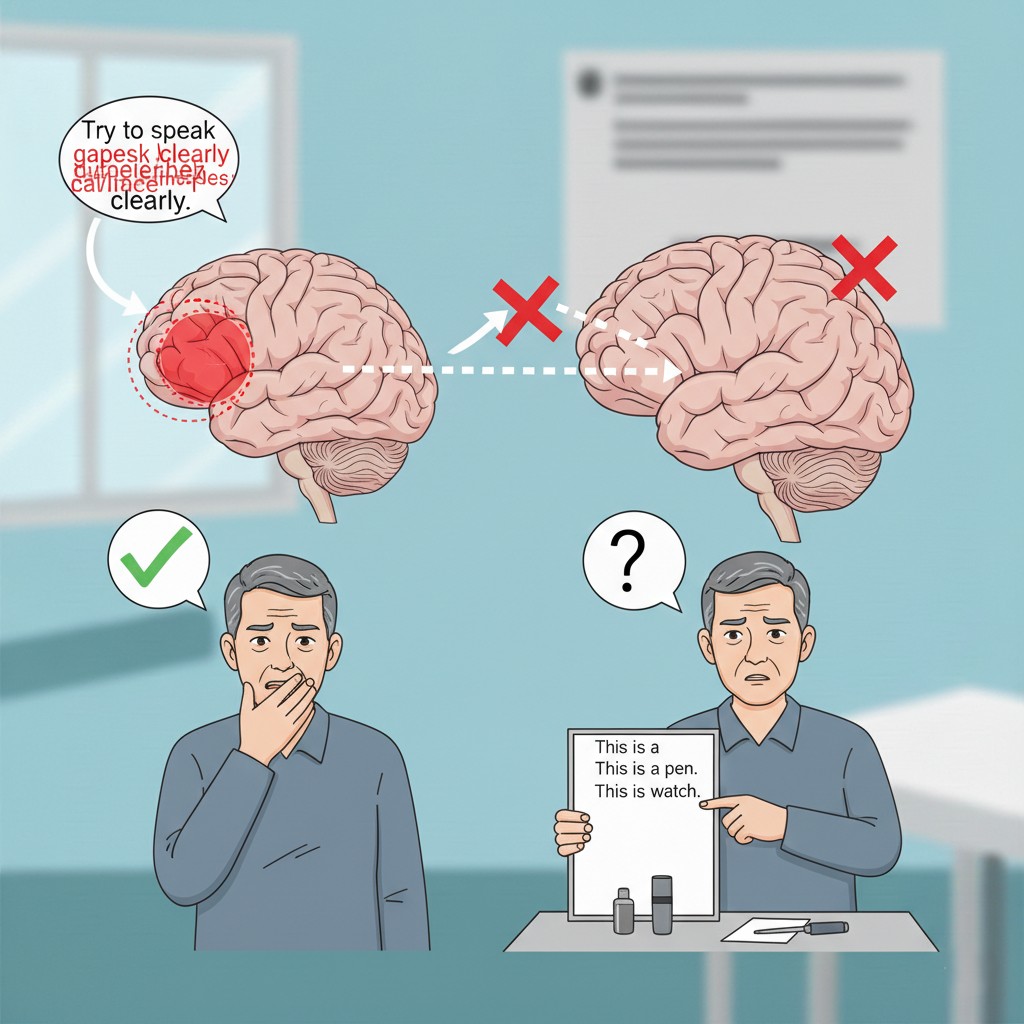
Aphemia typically results from a focal lesion in the left frontal operculum that notably spares the classic Broca's area, leading to pure motor speech deficits without true language impairment.
Clinical Features and Terminology
The hallmark of modern aphemia is the stark dissociation between impaired speech output and completely preserved language comprehension. Because there are ongoing debates regarding whether the core deficit is fundamentally an aphasia, a dysarthria, or an apraxia, aphemia has accumulated a wide variety of synonymous or overlapping terms in the medical literature. These include:
- Pure anarthria
- Phonetic disintegration (as opposed to phonemic disintegration)
- Apraxic dysarthria or cortical dysarthria
- Verbal apraxia or speech apraxia
- Subcortical motor aphasia or pure motor aphasia
- Small or "mini" Broca’s aphasia
- Kinetic speech production disorder
Interestingly, aphemia likely encompasses at least some cases of the rare "foreign accent syndrome." In this fascinating clinical presentation, altered speech production, disrupted articulation, and changes in prosody (the rhythm and melody of speech) make the patient's native speech output sound to listeners as if they are speaking with a foreign accent.
Pathophysiology and Anatomical Correlates
Conceptually and anatomically, aphemia conditions stand in the borderland between pure disorders of motor speech execution (dysarthrias) and pure disorders of central language processing (aphasias).
Neuroanatomically, aphemia is most commonly associated with highly localized damage to the left frontal operculum—the cortical area immediately adjacent to, but critically sparing, Broca’s area. Because Broca's area itself and the broader language networks are spared, the patient does not exhibit the classical agrammatism or linguistic errors typical of true Broca's aphasia. The lesions causing aphemia are typically small ischemic strokes or focal hemorrhages.
References
Lecours AR, Lhermitte F. The "pure" form of the phonetic disintegration syndrome (pure anarthria): anatomo-clinical report of a single case. Brain and Language 1976; 3: 88-113
Pearce JMS. Aphasia or aphemia. In: Pearce JMS. Fragments of neurological history. London: Imperial College Press, 2003: 69
Schiff HB, Alexander MP, Naeser MA, Galaburda AM. Aphemia: clinical-anatomic correlations. Archives of Neurology 1983; 40: 720-727
Cross References
Anarthria; Aphasia; Aprosodia, Aprosody; Dysarthria; Phonemic disintegration; Speech apraxia
Need Expert Advice on Your Condition?
Get a personalized video breakdown and treatment plan from our senior neurosurgeons using your MRI/CT scans.
👉 Request MRI Review