
Aphasia
Definition and Core Concepts
Aphasia, sometimes referred to as dysphasia, is an acquired loss or impairment of language function. Language is defined as the complex cognitive system of symbols used for communication, encompassing both spoken and written forms (reading and writing). It involves multiple linguistic components, including phonology (sounds), semantics/lexical access (meaning and vocabulary), and syntax (grammar).
Crucially, aphasia is distinguished from speech disorders. Speech refers to the mechanical, oral production of communication; disorders of speech execution are termed dysarthria or anarthria. While dysarthria and aphasia may coexist in a patient, they are anatomically and clinically separable entities. Language processing relies heavily on the integrity of the dominant cerebral hemisphere (typically the left hemisphere in the vast majority of right-handed and most left-handed individuals). Nonlinguistic components of language, such as emotion, inflection, and cadence—collectively known as prosody—often require contributions from the non-dominant hemisphere as well.
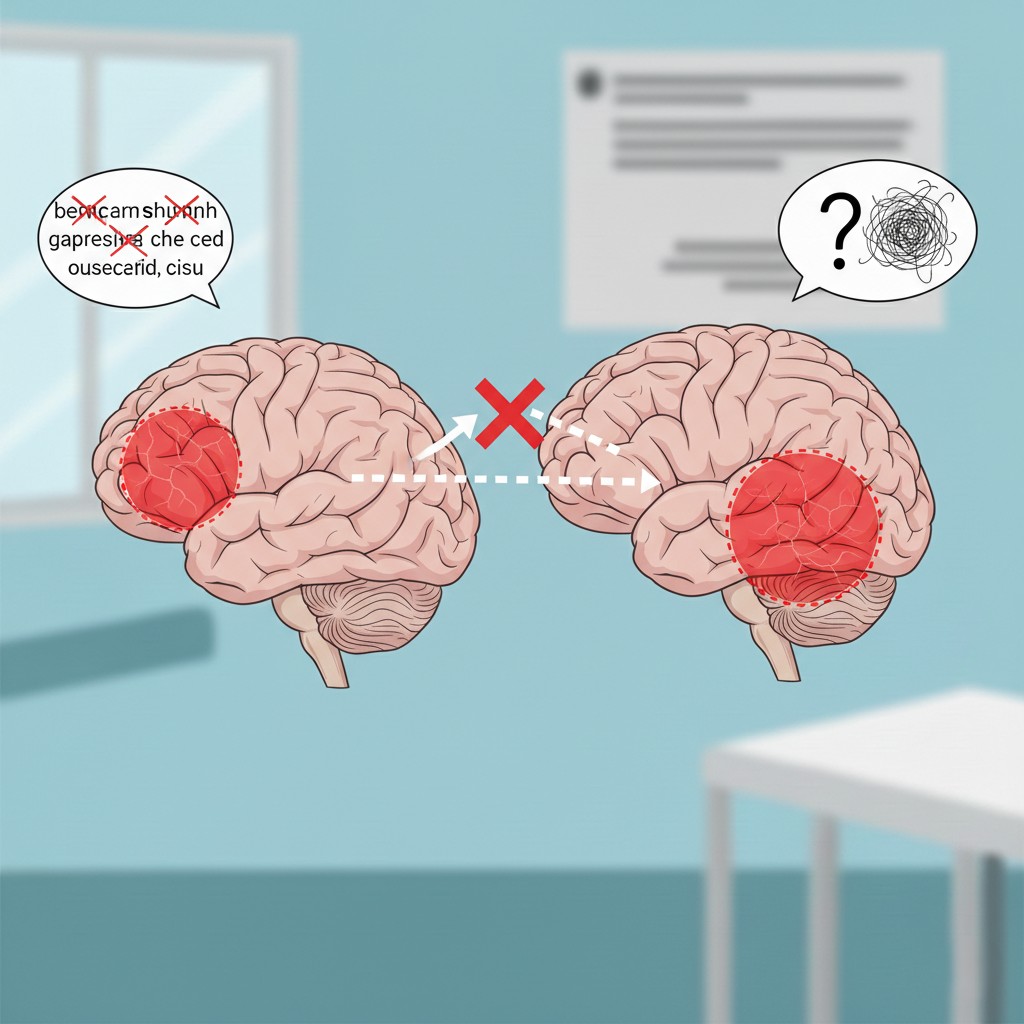
Aphasia typically results from lesions in the language-dominant hemisphere, often disrupting critical nodes such as Broca's area, Wernicke's area, or the connecting arcuate fasciculus.
Clinical Assessment
A systematic clinical assessment of aphasia requires a thorough analysis of six core language domains. This is achieved by listening to the patient’s spontaneous speech, asking questions, giving commands, and asking the patient to perform specific tasks:
- Fluency: Is the verbal output effortful, labored, and characterized by agrammatism and dysprosody (nonfluent)? Or is it flowing and articulate, but filled with paraphasias and neologisms (fluent)?
- Comprehension: Is the patient's ability to understand spoken language spared or impaired? Can they follow multi-step commands?
- Repetition: Is the ability to repeat words and phrases (e.g., "no ifs, ands, or buts") preserved or impaired?
- Naming: Does the patient exhibit anomia (word-finding difficulty) during confrontation naming tasks?
- Reading: Is there evidence of alexia (acquired inability to read)?
- Writing: Is there evidence of agraphia (acquired inability to write)?
Classification and Major Syndromes
Evaluating the features above allows clinicians to classify the aphasia into specific syndromes, which traditionally carry localizing value:
- Motor ("Expressive") Aphasias (e.g., Broca's Aphasia): Characterized by nonfluent, halting verbal output with relatively intact or largely preserved comprehension. Patients are often acutely aware of and frustrated by their deficit.
- Sensory ("Receptive") Aphasias (e.g., Wernicke's Aphasia): Characterized by fluent but empty verbal output, frequent paraphasias, sometimes deteriorating into jargon aphasia, accompanied by severely impaired comprehension. Patients are often unaware of their deficit (anosognosia).
- Conduction Aphasia: Marked by relatively normal, fluent spontaneous speech (though with some paraphasic errors) and intact comprehension, but presenting with a profound and disproportionate deficit in repetition.
- Transcortical Aphasias: These syndromes mirror Broca's, Wernicke's, or Global aphasia, but uniquely, the ability to repeat is strikingly preserved.
Summary of Findings in Aphasia Syndromes
The following table summarizes the classic patterns of impairment across the major aphasic syndromes (N = Normal/Preserved; ↓ = Impaired; ↓↓ = Severely Impaired):
| Clinical Feature | Broca's Aphasia | Wernicke's Aphasia | Conduction Aphasia | Transcortical (Motor/Sensory) |
|---|---|---|---|---|
| Fluency | ↓↓ | N | N | ↓ / N |
| Comprehension | N | ↓↓ | N | N / ↓ |
| Repetition | ↓ | ↓ | ↓↓ | N / N |
| Naming | ↓ | ↓ | ↓ | ↓ / ↓ |
| Reading | ↓ | ↓ | ↓ | N? / N? |
| Writing | ↓ | ↓ | ↓ | N? / N? |
Causes and Pathophysiology
Aphasias most commonly follow an acute cerebrovascular event, particularly ischemic strokes affecting the territory of the left middle cerebral artery (MCA). The specific type of aphasia may evolve over time; for instance, a global aphasia may resolve into a Broca's aphasia as swelling decreases. It is also important to note that discrepancies frequently exist between the classically defined clinicoanatomical syndromes and the actual neuroimaging findings encountered in everyday clinical practice due to individual variations in vascular anatomy and neural networking.
Aphasia may also result from space-occupying lesions (tumors, abscesses) and traumatic brain injuries. Furthermore, it is a prominent feature in neurodegenerative disorders. It can occur alongside widespread cognitive impairments (e.g., advanced Alzheimer’s disease) or present as an isolated, slowly progressive language deficit known as Primary Progressive Aphasia (PPA), which encompasses variants like semantic dementia and progressive non-fluent aphasia.
References
Basso A. Aphasia and its therapy. Oxford: OUP, 2003
Benson DF, Ardila A. Aphasia: a clinical perspective. New York: OUP, 1996
Caplan D. Aphasic syndromes. In: Heilman KM, Valenstein E (eds.). Clinical neuropsychology (4th edition). Oxford: OUP, 2003: 14-34
Damasio AR. Aphasia. New England Journal of Medicine 1992; 326: 531-539
Saver JL. Approach to the patient with aphasia. In: Biller J (ed.). Practical neurology (2nd edition). Philadelphia: Lippincott Williams & Wilkins, 2002: 27-39
Spreen O, Risser AH. Assessment of aphasia. Oxford: OUP, 2003
Willmes K, Poeck K. To what extent can aphasic syndromes be localized? Brain 1993; 116: 1527-1540
Cross References
Agrammatism; Agraphia; Alexia; Anomia; Aprosodia, Aprosody; Broca’s aphasia; Circumlocution; Conduction aphasia; Conduit D’approche; Crossed aphasia; Dysarthria; Jargon aphasia; Neologism; Optic aphasia; Paraphasia; Transcortical aphasias; Wernicke’s aphasia
Need Expert Advice on Your Condition?
Get a personalized video breakdown and treatment plan from our senior neurosurgeons using your MRI/CT scans.
👉 Request MRI Review