
Educational Content: This article is for informational purposes only and does not constitute medical advice. Always consult a healthcare provider for diagnosis and treatment.
Nipah Virus Infection
Medically reviewed by Dr. Otari Nergadze, Neurosurgeon | Updated: January 2026
- Facts
-
Causes
- What is Nipah virus infection (NiV)?
-
Contagious
- Is a Nipah virus infection contagious?
- What is the incubation period for a Nipah virus infection?
- What is the contagious period for a Nipah virus infection?
-
Risk Factors
- What are risk factors for a Nipah virus infection?
-
Symptoms
- What are signs and symptoms of a Nipah virus infection?
- Diagnosis
- Treatments
- Prognosis
- Prevention
Nipah virus infection (NiV) facts
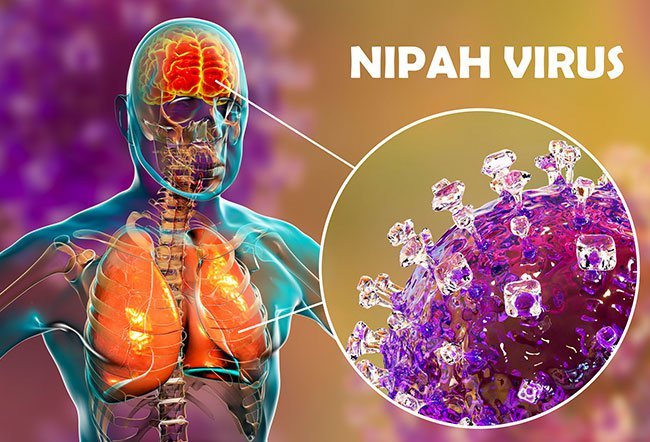
- Nipah virus (NiV) is a member of the family Paramyxoviridae, genus Henipavirus and is related to Hendra virus that infects horses.
- NiV is a zoonotic virus (a disease that animals can transmit to humans, known as a zoonosis); the virus often infects animals such as pigs and fruit bats (Pteropodidae), but they may be asymptomatic (not show any symptoms). In addition, flying foxes of the genus Pteropus in the Malaysian peninsula can carry NiV.
- People first discovered NiV in a village named Kampung Sungai Nipah in 1999 in Malaysia; the virus was named after the village. This first recorded outbreak began in 1998-1999 and reached Singapore. A new strain occurred in 2001 in Bangladesh and India. Small outbreaks of NiV have happened in these countries since 2001. An outbreak in India (state of Kerala) occurred in May 2018. Fruit bats and rabbits are the likely sources of NiV that infected people. The Indian government sources say that the situation is currently under control. During this outbreak, at least 11 people have died and another 14 people contracted the virus, while another 22 are awaiting test results.
- Humans who have direct contact with infected fruit bats or infected pigs are the usual way an outbreak begins. However, the consumption of raw date palm sap contaminated with bat feces is another common way to get the disease. Human-to-human transmission occurs during close contact between family members and/or medical caregivers.
- myalgia (muscle aches),
- sore throat,
- vomiting,
- dizziness and/or
- acute respiratory syndrome or atypical pneumonia.
Encephalitis follows and those infected may exhibit
- drowsiness,
- disorientation,
- mental confusion,
- altered consciousness, and
- seizures that can progress, within 24-48 hours, to coma and eventually death.
What tests diagnose a Nipah virus infection?
A combination of tests that diagnoses NiV includes the following.
- Viral isolation,
- RT-PCR, and
- antibody detection by the ELISA tests is the test that health care professionals use most often to diagnose Nipah virus infection.
What are treatments for a Nipah virus infection?
- According to the U.S. Centers for Disease Control and Prevention (CDC), supportive care is the only current treatment for this viral infection.
- There is no vaccine specifically available to protect humans.
- However, some researchers suggest that the antiviral drug ribavirin may be useful, but there is little or no data to support this.
- A human monoclonal antibody that targets the G glycoprotein of NiV has shown benefit in a ferret animal model of this disease, but researchers have not studied the effects of the antibody in humans.
What is the prognosis of a Nipah virus infection?
- The prognosis of NiV infections is fair to poor.
- The fatality rate is estimated by the World Health Organization (WHO) to range from 40%-75%, depending upon the local capabilities for surveillance and clinical management (supportive care).
- Survivors may have residual neurological problems such as seizures and/or personality changes.
- A few survivors who recover may subsequently relapse or develop delayed onset encephalitis.
Is there a way to prevent Nipah virus infections?
There are ways to reduce the risk of developing NiV infections.
- For example, individuals should avoid date palm sap and any bats or potentially infected domestic animals such as infected pigs.
- The WHO suggests that health care professionals wear gloves and other protective clothing during any pig slaughtering and culling procedures.
- Avoid contagion, the communication of disease from one person to another by close contact.
- Medical caregivers should employ quarantine methods and use barrier methods such as gloves, masks, and disposable gowns, as they are at high risk of person-to-person transmission of NiV.
- Boiling freshly collected date palm juice
- Thoroughly washing and peeling all fruits before you eat them
- Throwing away any fruit with signs of bat bites
- Considering the presence of fruit bats when establishing a farm
- Keeping pig feed and pig sheds protected from bats
Need Expert Advice on Your Condition?
Get a personalized video breakdown and treatment plan from our senior neurosurgeons using your MRI/CT scans.
👉 Request MRI Review