
Aura
Definition and Clinical Features
An aura is a brief, subjective feeling, sensation, or perceptual experience—typically lasting seconds to minutes—that occurs immediately before the onset of a paroxysmal neurological event, such as an epileptic seizure or a migraine attack. It serves as a "warning" of the imminent clinical presentation, although auras can sometimes occur in isolation without progressing to a full seizure or headache.
Crucially, an aura is the earliest clinical manifestation of the neurological event and indicates the focal onset of neurological dysfunction. Because they are exclusively subjective experiences, they must be described by the patient. Auras may be purely elementary sensory experiences (like a flash of light) or highly complex, psychosensory, and experiential phenomena.
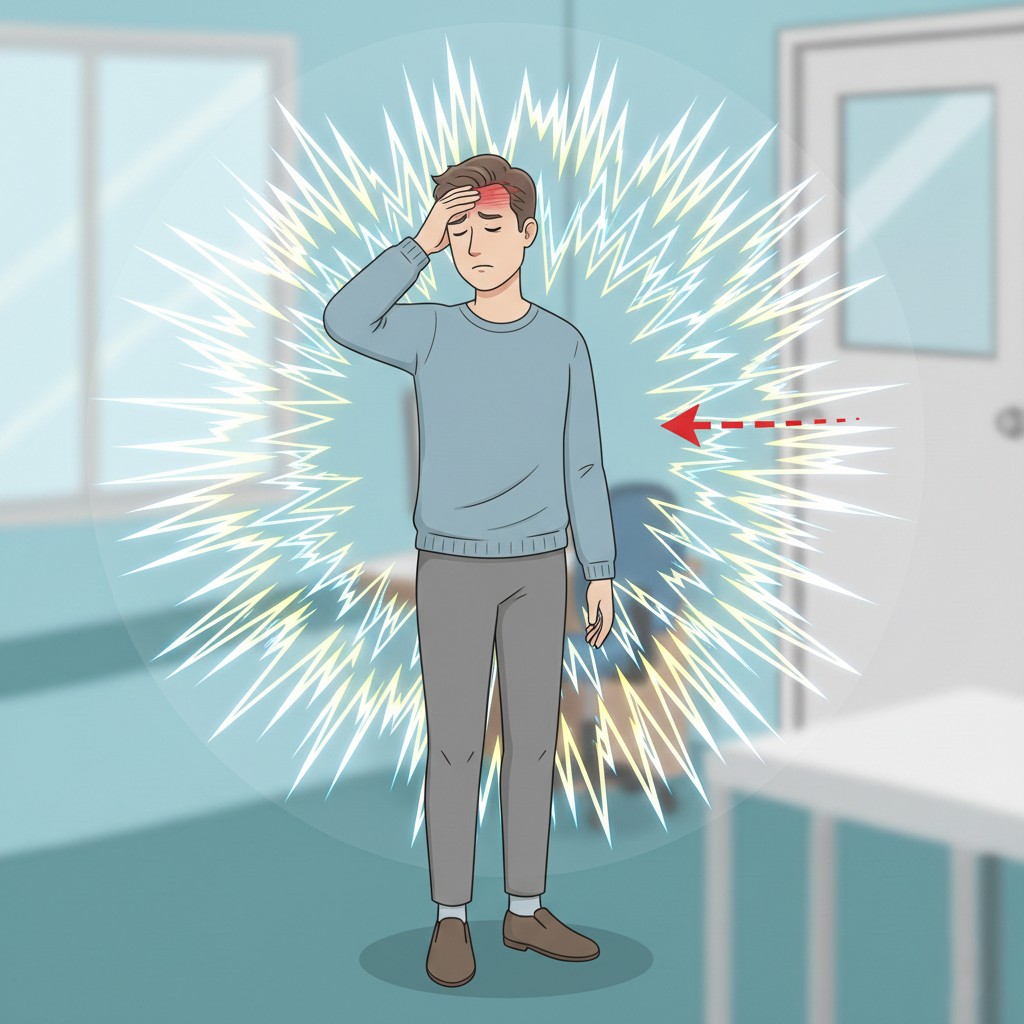
Visual auras, such as scintillating scotomas or fortification spectra, are classic subjective phenomena that gradually spread across the visual field prior to a migrainous headache.
Migraine Aura
In the context of migraine (often referred to as "migraine with aura" or "classical migraine"), the aura is typically caused by cortical spreading depression. The most common manifestations are visual, such as scintillating scotomas or fortification spectra (teichopsia). Sensory auras, such as spreading tingling or numbness (often following a cheiro-oral distribution), and dysphasic auras are also well-described in migraineurs.
Epileptic Auras and Anatomical Localization
In epilepsy, the aura actually constitutes a simple partial seizure (focal aware seizure) that may or may not generalize. The specific phenomenology of the aura is highly valuable for localizing the epileptogenic focus. Epileptic auras are classified into several subgroups:
- Somatosensory: Sensations of tingling, numbness, or electrical currents (paresthesias), typically indicating an origin in the primary somatosensory cortex (postcentral gyrus).
- Visual: Hallucinations or illusions. Elementary visual auras (flashes of light, colors, or visual loss) are common to both occipital and temporal lobe seizures. Complex hallucinations and a "tunnel vision" phenomenon are highly suggestive of seizures originating in the anteromedial temporal and occipitotemporal regions.
- Auditory: Ringing, buzzing, or muffled sounds, which may indicate an origin in the superior temporal gyrus (Heschl's gyrus).
- Olfactory: The perception of an abnormal, often unpleasant smell (parosmia or cacosmia). This is a hallmark of seizures of medial temporal lobe origin, specifically involving the uncus (historically termed "uncinate fits").
- Gustatory: Abnormal taste sensations, often pointing to an onset in the insula or parietal operculum.
- Autonomic: Sensations such as palpitations, sweating, flushing, or piloerection.
- Abdominal (Visceral): A "rising epigastric sensation" (often described as butterflies in the stomach rising to the throat). This is the most common aura associated with mesial temporal lobe epilepsy.
- Psychic (Experiential): Complex cognitive or emotional experiences, such as sudden, unprovoked fear, depersonalization, or distortions of familiarity like déjà vu or jamais vu. These are strongly indicative of a temporal lobe and limbic system onset.
References
Bien CG, Benninger FO, Urbach H, Schramm J, Kurthen M, Elger CE. Localizing value of epileptic visual auras. Brain 2000; 123: 244-253
Lüders H, Acharya J, Baumgartner C et al. Semiological seizure classification. Epilepsia 1998; 39: 1006-1013
Palmini A, Gloor P. The localizing value of auras in partial seizures. Neurology 1992; 42: 801-808
Cross References
"Alice in Wonderland" syndrome; Déjà vu; Fortification spectra; Hallucination; Illusion; Jamais vu; Parosmia; Seizure; "Tunnel vision"
Need Expert Advice on Your Condition?
Get a personalized video breakdown and treatment plan from our senior neurosurgeons using your MRI/CT scans.
👉 Request MRI Review