
Auditory Agnosia
Definition and Clinical Features
Auditory agnosia is a rare, higher-order neurological deficit characterized by an inability to recognize or appreciate the meaning of sounds, despite having intact peripheral hearing. A patient with this condition will have normal pure-tone audiometry and an intact auditory nerve, meaning they can "hear" a sound but cannot identify what the sound represents.
Depending on the specific location of the cortical damage, this recognition failure can affect verbal material (speech), nonverbal environmental sounds (such as a ringing telephone or a dog barking), or the perception of music.
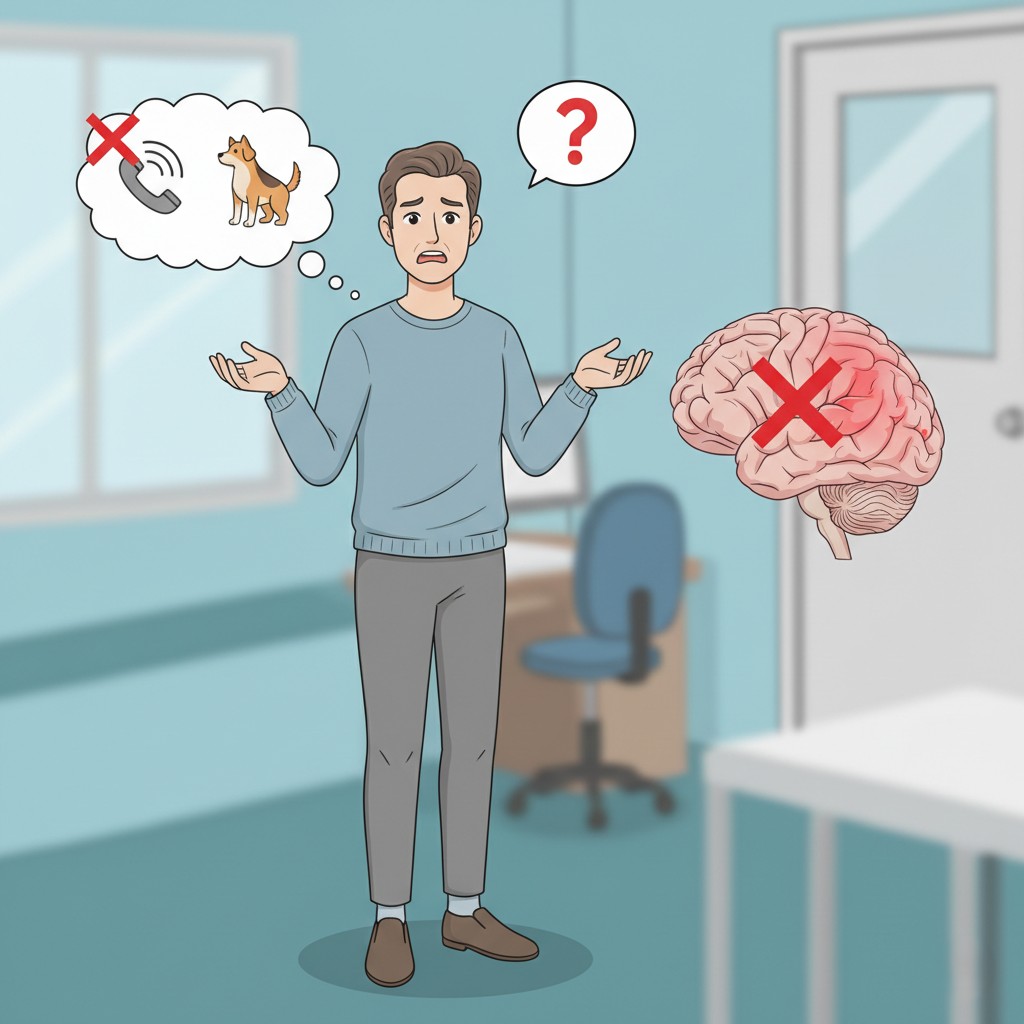
Auditory agnosia typically results from bilateral lesions to the auditory association cortices in the superior temporal gyri, rendering the patient unable to recognize sounds despite intact hearing pathways.
Clinical Subtypes
Auditory agnosia is highly heterogeneous and can be fractionated into distinct clinical subtypes based on the specific category of sound the patient fails to recognize:
- Verbal Auditory Agnosia (Pure Word Deafness): The patient is profoundly unable to comprehend spoken language. They hear the speaker's voice but cannot decode the phonetic structure, often likening it to a meaningless noise or a foreign language. However, spontaneous speech, reading, writing, and the recognition of nonverbal sounds are remarkably preserved.
- Nonverbal Auditory Agnosia: The selective inability to recognize environmental sounds (e.g., bells, whistles, animal noises, sirens) while the comprehension of spoken language remains intact.
- Receptive Amusia (Sensory Amusia): A specific inability to recognize, appreciate, or distinguish musical tones or rhythms, effectively rendering the patient "tone deaf" to previously familiar music.
- Phonagnosia: An impairment in the ability to recognize familiar voices, despite being able to understand the words being spoken and possessing normal hearing.
- Global Auditory Agnosia: A combined deficit where the patient fails to recognize both verbal and nonverbal sounds, behaving as if they are entirely deaf despite normal audiometry.
Pathophysiology and Anatomical Correlates
The neuroanatomical substrate for auditory agnosia involves the auditory association cortices, primarily located in the superior temporal gyrus (Brodmann areas 22 and 42) and surrounding temporal structures.
Global auditory agnosia typically requires bilateral lesions of the superior temporal gyri. However, more selective deficits can occur with unilateral damage due to hemispheric specialization:
- Left Hemisphere Lesions: More likely to cause verbal auditory agnosia (pure word deafness) by disconnecting the primary auditory cortex (Heschl's gyrus) from Wernicke's area, disrupting phonetic processing.
- Right Hemisphere Lesions: More likely to result in nonverbal auditory agnosia, amusia, or phonagnosia, reflecting the right hemisphere's dominance in processing pitch, prosody, and complex environmental acoustics.
These lesions can result from cerebrovascular accidents (strokes), central nervous system infections (such as Herpes simplex encephalitis, which has a predilection for the temporal lobes), cerebral tumors, or neurodegenerative conditions.
Cross References
Agnosia; Amusia; Phonagnosia; Pure word deafness
Need Expert Advice on Your Condition?
Get a personalized video breakdown and treatment plan from our senior neurosurgeons using your MRI/CT scans.
👉 Request MRI Review