
Asynergia
Definition and Clinical Features
Asynergia, also known as dyssynergia, is a neurological sign characterized by the lack or impairment of synergy during the sequential contraction of muscles. In a healthy nervous system, the simultaneous and sequenced contraction of agonist and antagonist muscle groups allows for smooth, fluid, and complex motor actions. When this synergy is lost, voluntary movements lose their fluidity and instead appear fragmented.
This fragmentation is classically referred to as the decomposition of movement. A patient attempting a multi-joint action will break the fluid motion down into its individual, constituent parts, performing each step sequentially in a robotic, disjointed manner rather than as a single coordinated sweep.
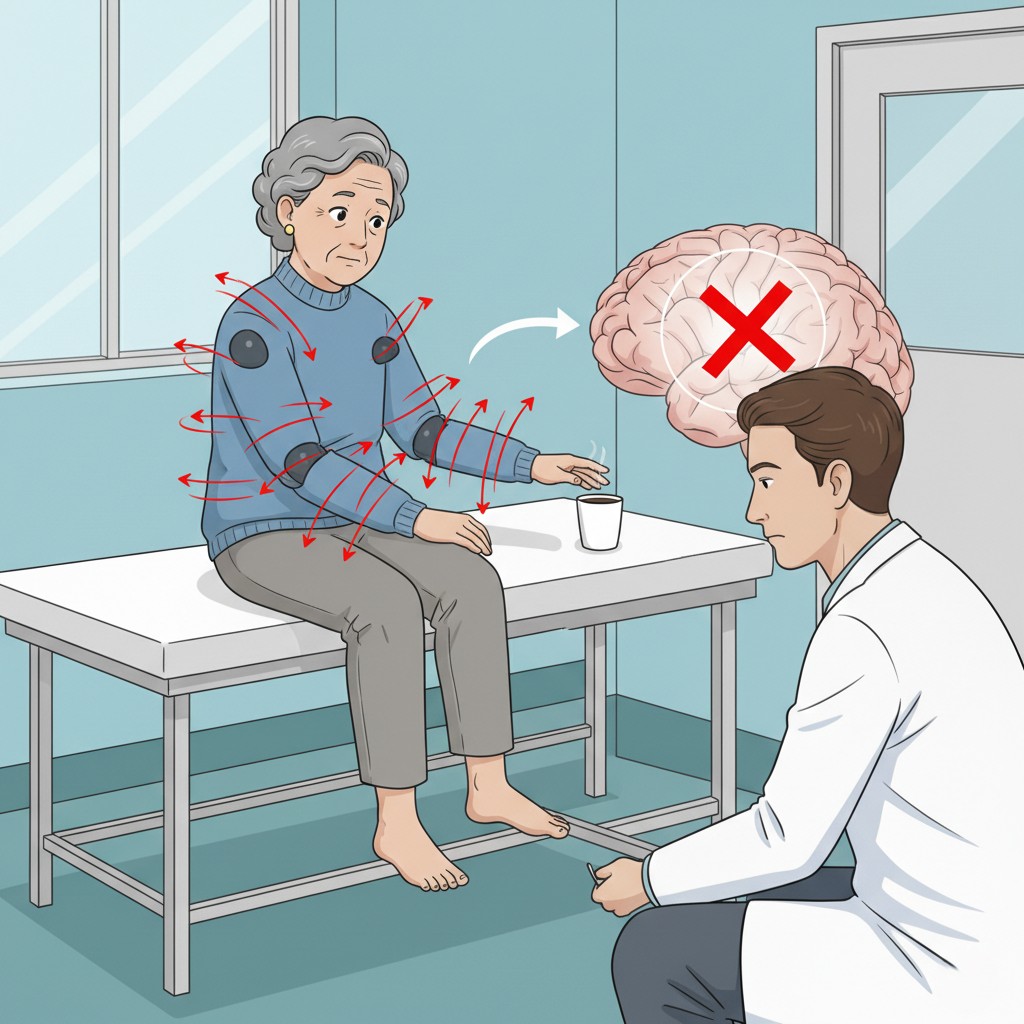
Asynergia results in the "decomposition of movement," where a smooth, multi-joint action is broken down into a series of stiff, disjointed steps.
Clinical Manifestations
Asynergia can manifest across various motor systems, leading to distinct clinical signs:
- Limb Asynergia: This is readily observed during clinical testing, such as the finger-to-nose test or the heel-to-shin test. Instead of smoothly bringing the finger to the nose in one fluid arc, the patient may first flex the shoulder, then the elbow, and finally extend the finger in distinct, jerky phases. It is also highly evident when patients attempt to perform rapid alternating hand movements.
- Speech Dyssynergia: The musculature of the vocal tract requires extremely precise coordination. Asynergia here produces a phenomenon known as scanning speech or scanning dysarthria. The patient's speech loses its normal melodic intonation (prosody) and is broken up into separate, equally stressed syllables, often with inappropriate, extended pauses between them.
Pathophysiology and Anatomical Correlates
Asynergia is a hallmark feature of cerebellar syndromes. The cerebellum is fundamentally responsible for the precise timing, scaling, and coordination of muscle contractions. Specifically, asynergia is most often seen with lesions affecting the lateral cerebellar hemispheres (the cerebrocerebellum or neocerebellum), which are deeply involved in motor planning and the execution of complex, multi-joint limb movements.
Clinically, asynergia almost never occurs in isolation. It frequently coexists with other classical signs of cerebellar disease, including:
- Ataxia (general lack of coordination and balance)
- Dysmetria (past-pointing or failing to accurately reach a target)
- Dysdiadochokinesia (the inability to smoothly perform rapid alternating movements)
Cross References
Ataxia; Cerebellar syndromes; Dysarthria; Dysdiadochokinesia; Dysmetria; Scanning speech
Need Expert Advice on Your Condition?
Get a personalized video breakdown and treatment plan from our senior neurosurgeons using your MRI/CT scans.
👉 Request MRI Review