
Asterixis
Definition and Clinical Presentation
Asterixis (from Greek a- meaning "not" and sterixis meaning "fixed position") is a motor disorder characterized by a sudden, brief, arrhythmic lapse of sustained posture. Often colloquially referred to as a "flapping tremor," it is not a true tremor but rather an involuntary interruption in ongoing muscle contraction.
Clinically, it manifests as a sudden downward dropping or "flapping" of the hands when the wrists are held in extension, immediately followed by a rapid, compensatory upward jerk to restore the original posture. It can affect any muscle group maintaining a sustained posture, including the tongue, eyelids, and lower extremities, but is most easily observed in the hands.
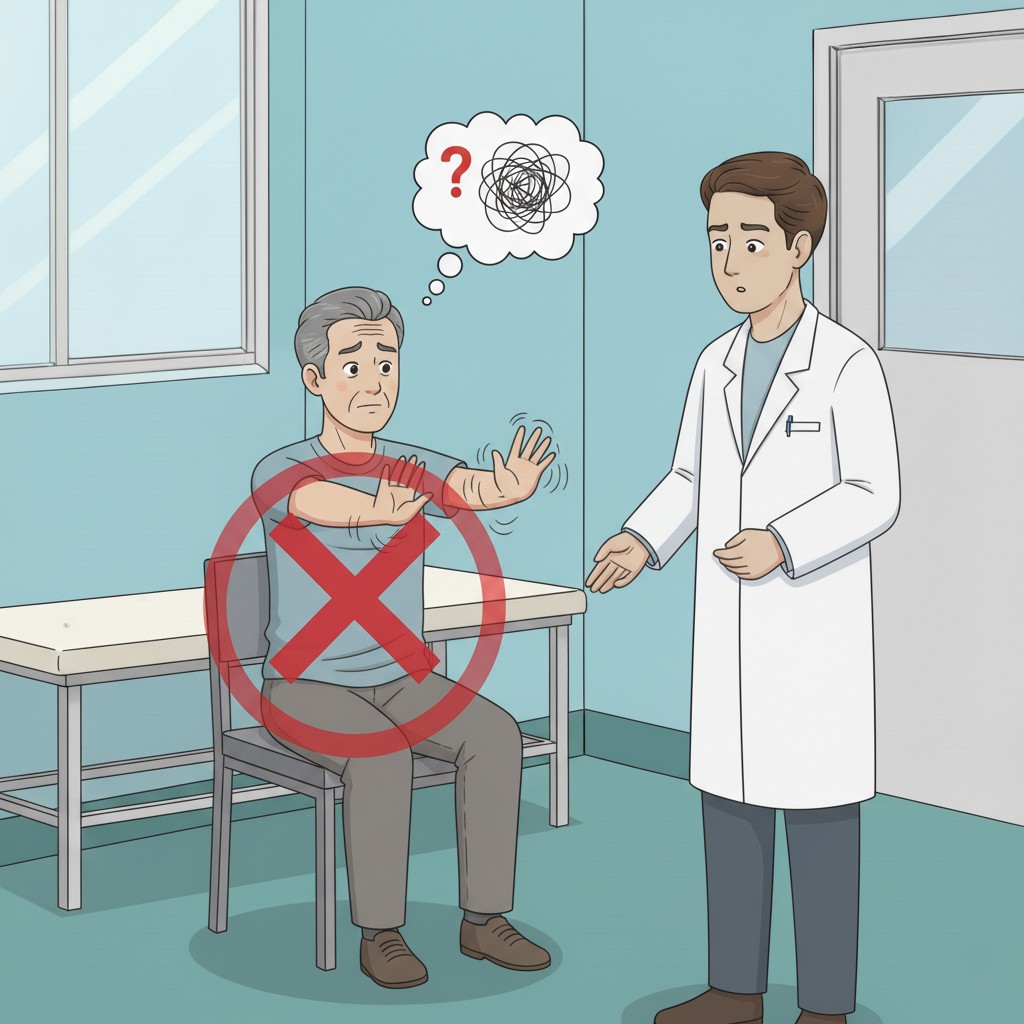
Asterixis is elicited by having the patient hold their arms outstretched with wrists dorsiflexed (the "stop" motion), resulting in a sudden, arrhythmic downward flap of the hands.
Clinical Examination Technique
To test for asterixis, the examiner asks the patient to extend their arms forward, spread their fingers, and forcefully dorsiflex their wrists (as if gesturing someone to "stop"). The patient should be instructed to hold this position for at least 30 seconds, as the lapses in posture may not occur immediately.
The examiner watches for arrhythmic, brief downward drops (flexion) of the hands or fingers, followed by a rapid return to the extended position. In subtle cases, having the patient close their eyes or lightly placing two fingers against the patient's extended fingers can help the examiner feel the momentary loss of extensor tone.
Pathophysiology and EMG Findings
Electromyography (EMG) is essential for understanding the pathophysiology of asterixis and distinguishing it from other movement disorders. Asterixis is characterized by an abrupt, brief electrical silence in the contracting antigravity muscles (lasting approximately 35 to 200 milliseconds).
Because the movement results from an absence of muscle contraction rather than an active contraction, the phenomenon is correctly classified as a negative myoclonus. This completely distinguishes asterixis from true tremor (which features rhythmic alternating agonist/antagonist muscle contractions) and positive myoclonus (which features sudden, active muscle jerks).
Etiology: Bilateral vs. Unilateral Causes
Asterixis may present bilaterally or unilaterally, which provides crucial diagnostic localization:
- Bilateral Asterixis: The most common presentation, typically signifying a diffuse toxic-metabolic encephalopathy. Recognized causes include:
- Hepatic encephalopathy (classic cause, originally leading to the term "liver flap")
- Hypercapnia (severe CO2 retention, often from COPD)
- Uremia (renal failure)
- Drug toxicity (e.g., anticonvulsants like phenytoin, barbiturates, or dopaminergic agents like levodopa)
- Unilateral Asterixis: Represents a focal structural brain lesion affecting the motor control networks. Unilateral asterixis has been described in the context of stroke or hemorrhage:
- Contralateral to lesions in the primary motor cortex, parietal lobe, thalamus (specifically the ventroposterolateral nucleus), and midbrain (involving corticospinal fibers and the medial lemniscus).
- Ipsilateral to lesions in the lower brainstem, specifically the pons or medulla.
References
Marchini M, Sayegh GA, Caudana R. Unilateral asterixis and stroke in 13 patients: localization of the lesions matching the CT scan images to an atlas. European Journal of Neurology 2004; 11(suppl2): 56 (abstract P1071)
Cross References
Encephalopathy; Myoclonus; Tremor
Need Expert Advice on Your Condition?
Get a personalized video breakdown and treatment plan from our senior neurosurgeons using your MRI/CT scans.
👉 Request MRI Review