
"Arm Drop"
Definition and Clinical Technique
The "arm drop" test, sometimes referred to as the "face-hand test" or "hand-drop test," is a bedside clinical maneuver historically suggested to help differentiate between organic (neurological) weakness and functional (psychogenic or non-organic) weakness. It is typically employed when a patient presents with apparent hemiparesis or an upper limb monoparesis.
The technique involves the patient lying in a supine position. The examiner lifts the patient's reportedly paralyzed or paretic arm, positions the hand directly over the patient's face, and then abruptly releases it.
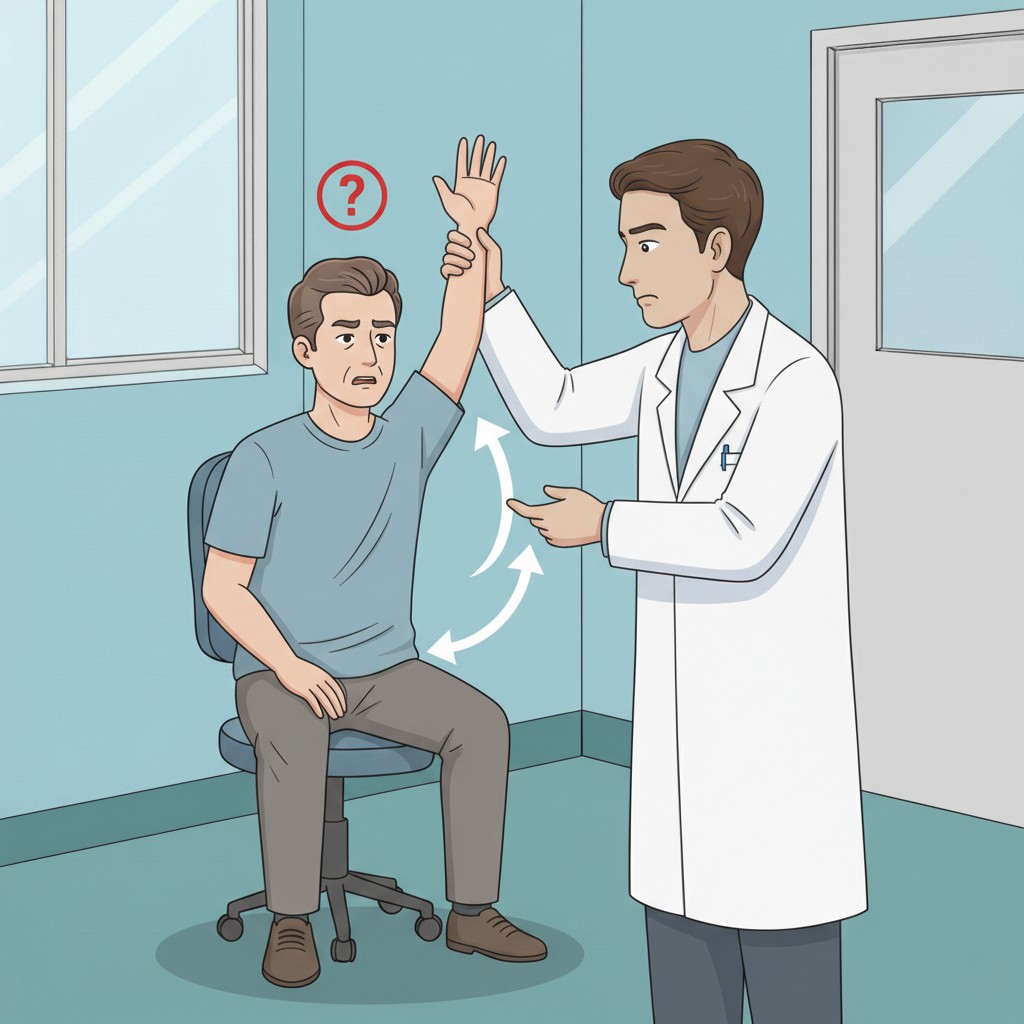
In the arm drop test, the examiner releases the patient's paretic hand over their face; a functional etiology is suspected if the hand subconsciously deflects to avoid striking the face.
Clinical Interpretation
The rationale behind the test relies on subconscious self-preservation mechanisms:
- Organic Weakness: In cases of true neurological paralysis (such as from a stroke or structural lesion), the flaccid limb is entirely subject to gravity. Upon release, the hand will fall directly downward and hit the patient's face (the examiner must be prepared to catch the hand to prevent actual injury).
- Functional Weakness: In patients with functional weakness or conversion disorder, subconscious protective reflexes remain intact. When the arm is dropped, the hand will typically deflect to the side, sliding past the face, or hover briefly to avoid a direct impact.
Limitations and Ethical Considerations
Despite its historical use, the "arm drop" test is highly controversial in modern neurology. It is considered an "avoidance testing maneuver," and its validity and reliability have never been systematically or rigorously examined in clinical trials. Consequently, its clinical diagnostic value is doubtful.
Furthermore, the test carries significant ethical and practical limitations. It is inherently provocative and can be perceived as punitive or deceptive by the patient, which can damage the therapeutic physician-patient relationship. Additionally, there is a real risk of causing physical injury if an organically paralyzed arm is allowed to strike the patient's face. Modern neurological practice strongly favors more reliable and non-confrontational positive signs of functional weakness, such as Hoover's sign or the abductor sign.
References
Stone J, Zeman A, Sharpe M. Functional weakness and sensory disturbance. Journal of Neurology, Neurosurgery and Psychiatry 2002; 73: 241-245
Cross References
Babinski’s trunk-thigh test; Functional weakness and sensory disturbance; Hoover’s sign
Need Expert Advice on Your Condition?
Get a personalized video breakdown and treatment plan from our senior neurosurgeons using your MRI/CT scans.
👉 Request MRI Review