
Apraxia
Definition and Core Concepts
Apraxia (or dyspraxia) is a higher-order disorder of motor planning and execution. It is characterized by the inability to perform a learned, voluntary motor act despite having an intact motor system—meaning there is no underlying weakness, sensory loss, ataxia, or impairment in the level of consciousness that could explain the deficit.
A critical defining feature of apraxia is voluntary-automatic dissociation. Patients may be completely unable to perform an action on command (e.g., "show me how you would wave goodbye"), but they might spontaneously and flawlessly perform the exact same action in a natural, automatic context (e.g., waving goodbye to a visitor as they leave the room).
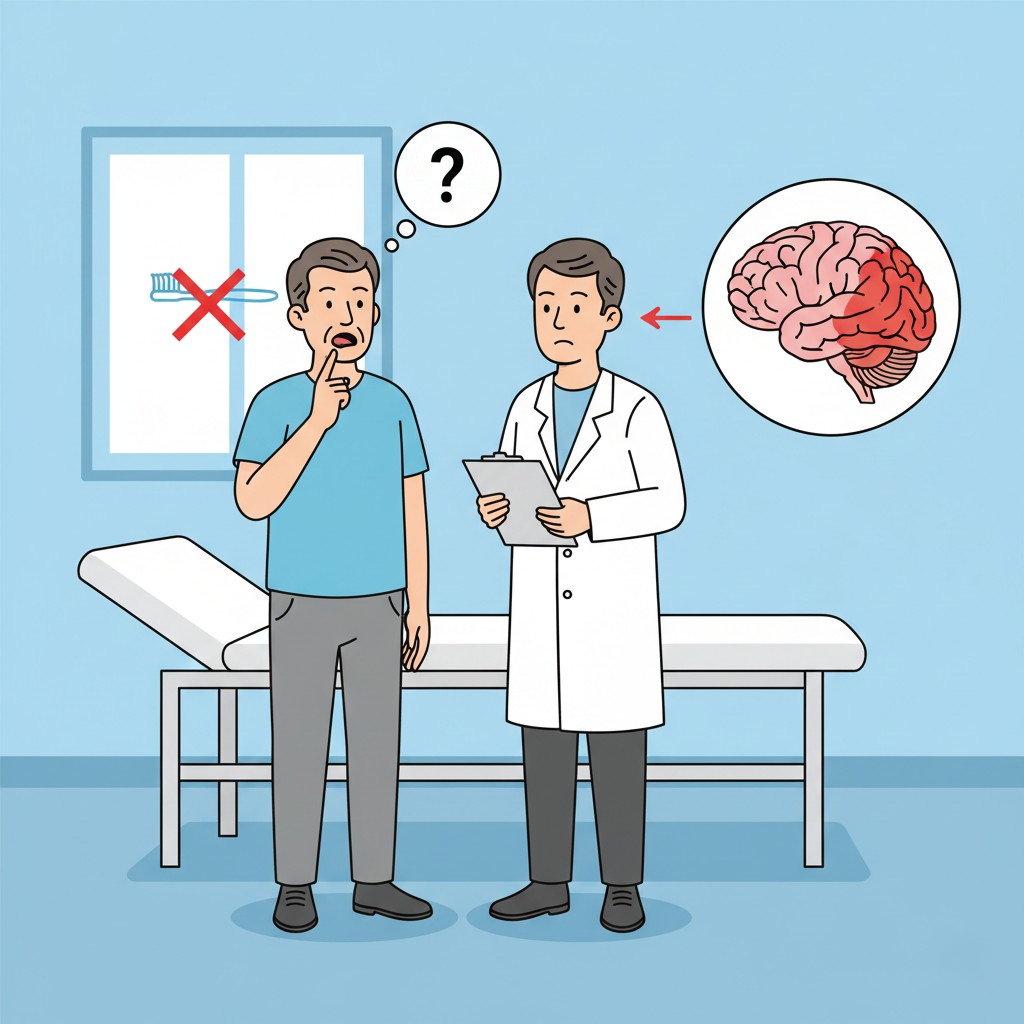
When asked to pantomime the use of a tool, patients with ideomotor apraxia often exhibit the "body part as object" sign, such as using their index finger as a toothbrush instead of pretending to hold one.
Classic Clinical Subtypes (Liepmann's Classification)
The traditional classification of apraxia, established by Hugo Liepmann in 1900, delineates three primary subtypes based on where the breakdown in the motor planning process occurs:
- Ideational (Conceptual) Apraxia: A deficit in the core concept or overall plan of a movement. Patients lose the knowledge of what an object is used for or how to sequence a multi-step task (e.g., making a cup of coffee). This frequently interferes with daily motor activities and is not facilitated by actually holding the physical object. It is often accompanied by aphasia.
- Ideomotor Apraxia (IMA): A disturbance in the selection and sequencing of motor elements to execute a known plan, often seen when pantomiming tool use. Unlike ideational apraxia, patients know what to do but cannot figure out how to do it on command. Providing the actual object often facilitates and corrects the movement. A hallmark clinical sign is the body part as object phenomenon. IMA typically does not severely interfere with spontaneous everyday activities due to the voluntary-automatic dissociation.
- Limb-Kinetic (Melokinetic) Apraxia: Characterized by slowness, clumsiness, and awkwardness in the fine, distal movements of a limb, with a temporal decomposition of the motor act. It is clinically very difficult to disentangle from pure, mild motor deficits associated with early corticospinal tract lesions.
Anatomical Classifications and Correlates
Apraxia is significantly more common and generally more severe following lesions in the left (language-dominant) hemisphere, as the left hemisphere typically dominates praxis network organization. Anatomically, apraxia can be localized to:
- Parietal (Posterior) Apraxia: Ideational and ideomotor apraxias are classically seen with unilateral lesions of the left inferior parietal lobule, the supramarginal gyrus, or the premotor cortex of the frontal lobe (Brodmann areas 6 and 8), as well as the arcuate fasciculus connecting them.
- Frontal (Anterior) Apraxia: Unilateral lesions of the supplementary motor area (SMA) are strongly associated with impairments in tasks requiring bimanual coordination. This leads to difficulties with alternating hand movements or drawing alternating patterns (e.g., Luria's alternating sequences test like "m n m n"). Frontal apraxia may be associated with the presence of a grasp reflex and alien limb phenomena, sometimes presenting similarly to limb-kinetic apraxia.
Diagnostic Challenges and Related Terms
Difficulties with the precise clinical definition and nosology of apraxia persist, much like with the agnosias. Several historically named "apraxias" are now recognized as deriving from different cognitive deficits:
- "Dressing apraxia" and "Constructional apraxia" are now predominantly considered to be secondary to visuospatial and neglect problems (typically right parietal lesions) rather than true disorders of motor praxis.
- Eyelid apraxia and Gait apraxia are often viewed as specific focal deficits or higher-level motor programming failures that do not neatly fit into classic ideational or ideomotor categories.
- The exact nosological status of speech apraxia (apraxia of speech) remains contentious, often existing on a spectrum with Broca's aphasia and pure anarthria.
References
Crutch S. Apraxia. Advances in Clinical Neuroscience & Rehabilitation 2005; 5(1): 16,18
Freund H-J. The apraxias. In: C Kennard (ed.). Recent advances in clinical neurology 8. Edinburgh, Churchill Livingstone, 1995: 29-49
Grafton S. Apraxia: a disorder of motor control. In: D’Esposito M (ed.). Neurological foundations of cognitive neuroscience. Cambridge: MIT Press, 2003: 239-258
Heilman KM, Gonzalez Rothi LG. Apraxia. In: Heilman KM, Valenstein E (eds.). Clinical neuropsychology (4th edition). Oxford: OUP, 2003: 215-235
Leiguarda RC, Marsden CD. Limb apraxias. Higher-order disorders of sensorimotor integration. Brain 2000; 123: 860-879
Pramstaller PP, Marsden CD. The basal ganglia and apraxia. Brain 1996; 119: 319-340
Cross References
Alien hand, Alien limb; Body part as object; Crossed apraxia; Eyelid apraxia; Forced groping; Frontal lobe syndromes; Gait apraxia; Grasp reflex; Optic ataxia; Speech apraxia
Need Expert Advice on Your Condition?
Get a personalized video breakdown and treatment plan from our senior neurosurgeons using your MRI/CT scans.
👉 Request MRI Review