
Anosmia
Definition and Clinical Testing
Anosmia is the complete inability to perceive smells due to damage anywhere along the olfactory pathways, which include the olfactory neuroepithelium, olfactory nerves, and the rhinencephalon. Clinically, olfaction may be tested using kits containing specific, familiar non-irritating odors (e.g., clove, turpentine, coffee). It is crucial that each nostril is separately tested. Unilateral anosmia can be highly localizing and may be due to pressure on the ipsilateral olfactory bulb or tract (e.g., due to a subfrontal meningioma).
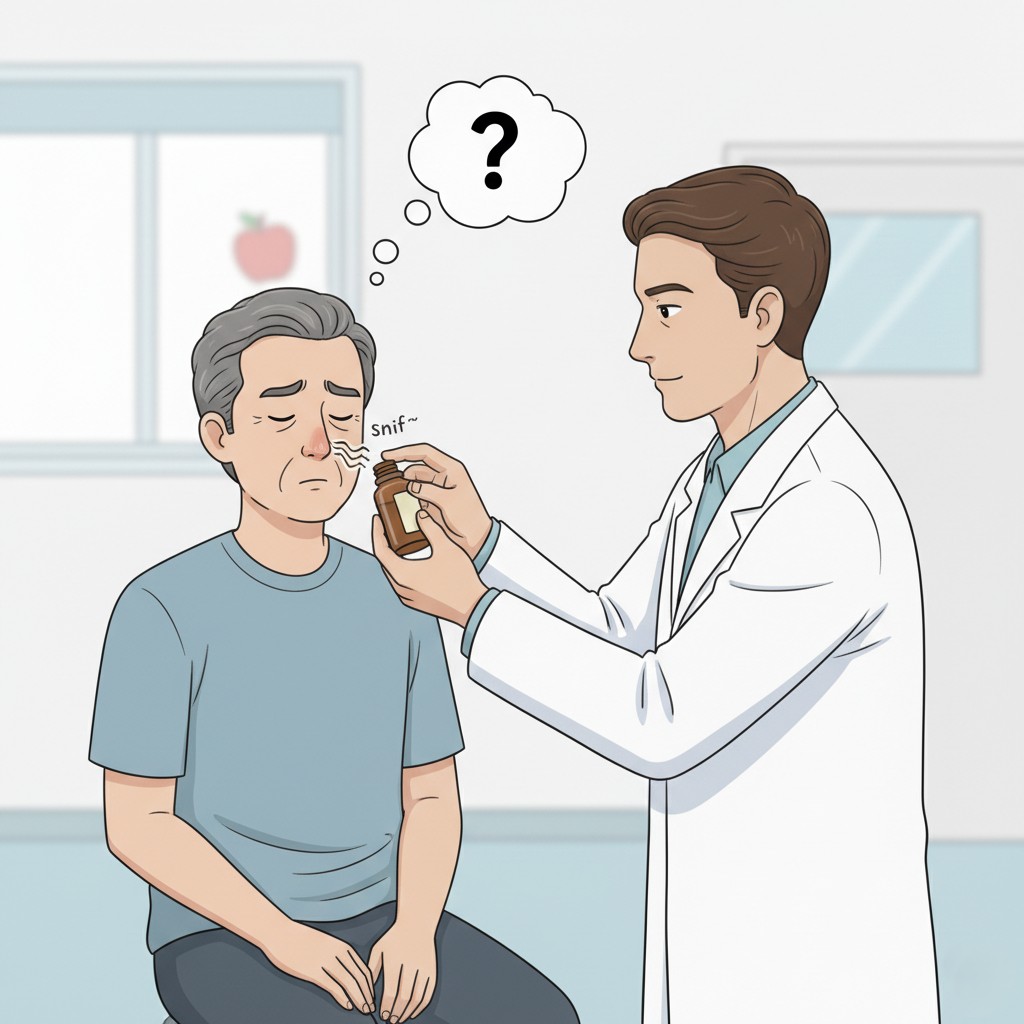
Olfaction is tested by presenting distinct odors to each nostril separately while the patient's eyes are closed, to evaluate the integrity of the first cranial nerve.
Causes and Pathophysiology
Anosmia can be broadly categorized into congenital and acquired causes:
- Congenital Anosmia: This can be seen in conditions like Kallmann syndrome (associated with hypogonadotrophic hypogonadism), which involves a primary disorder of neuronal migration affecting the development of the olfactory pathways.
- Acquired Rhinological Anosmia: Rhinological disease (such as allergic rhinitis, sinusitis, or coryza) is by far the most common overall cause. Chronic mucosal inflammation may also account for the impaired sense of smell often observed in smokers.
- Acquired Neurological Anosmia: Head trauma is the most common neurological cause. The mechanism is typically the shearing off of the delicate olfactory nerve fibers as they pass through the cribriform plate of the ethmoid bone during a traumatic brain injury. Notably, functional recovery is possible in this situation due to the unique capacity for neuronal and axonal regeneration within the olfactory neuroepithelium and pathways.
Associated Conditions
Beyond local trauma or nasal disease, olfactory dysfunction is increasingly recognized as a key feature in several systemic and central nervous system conditions:
- Neurodegenerative Disease: Olfactory dysfunction is well-described in Alzheimer’s disease and Parkinson’s disease. It frequently presents as an early phenomenon, preceding motor or prominent cognitive symptoms, due to the early pathological involvement (e.g., Lewy body or neurofibrillary tangle deposition) of the olfactory bulb and pathways.
- Psychiatric Disease: Patients with severe depression may complain of an impaired sense of smell.
- Physiological: A gradual loss of olfactory acuity (presbyosmia) may be a normal feature of ageing (age-related signs).
References
Finelli PF, Mair RG. Disturbances of taste and smell. In: Bradley WG, Daroff RB, Fenichel GM, Marsden CD (eds.). Neurology in clinical practice (3rd edition). Boston: Butterworth Heinemann, 2000: 263-269
Hawkes CH, Shephard BC. Olfactory evoked responses and identification tests in neurological disease. Annals of the New York Academy of Sciences 1998; 855: 608-615
Cross References
Age-related signs; Ageusia; Cacosmia; Dysgeusia; Mirror movements; Parosmia
Need Expert Advice on Your Condition?
Get a personalized video breakdown and treatment plan from our senior neurosurgeons using your MRI/CT scans.
👉 Request MRI Review