
Angioscotoma
Definition and Clinical Features
Angioscotomata (singular: angioscotoma) are shadow images of the superficial retinal vessels on the underlying retina, constituting a physiological scotoma (blind spot). Under normal daily conditions, individuals are entirely unaware of these linear blind spots because the visual cortex continuously "fills in" the missing visual information based on surrounding visual data.
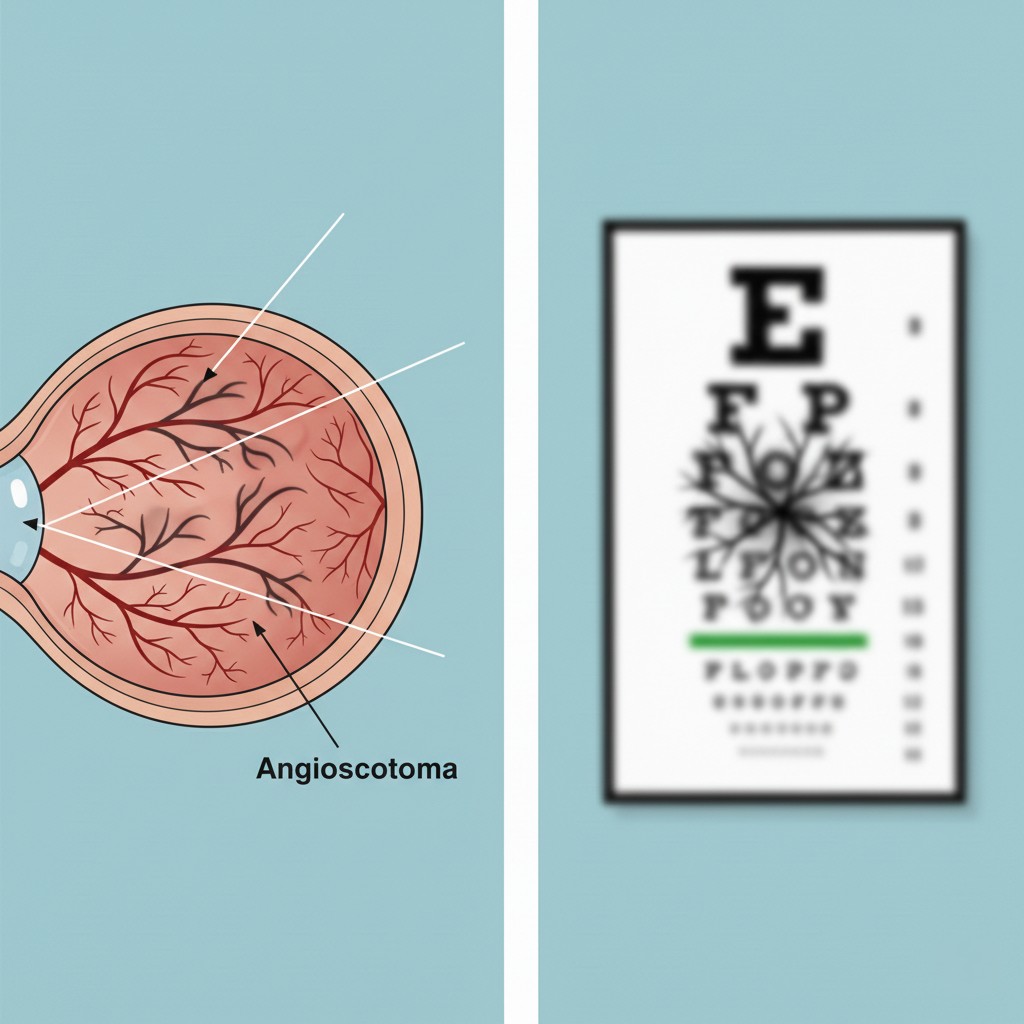
Angioscotomata are physiological blind spots formed because retinal blood vessels physically lie in front of the light-sensitive photoreceptors.
History and Etymology
The term derives from the Greek words angeion (meaning "blood vessel") and skotoma (meaning "darkness" or "blind spot"). The phenomenon of subjectively perceiving one's own retinal vessels was famously described in 1823 by the Czech anatomist Jan Evangelista Purkinje, and the resulting visual percept is often referred to as the "Purkinje tree."
Pathophysiology
The human retina has an "inverted" structure, meaning that the blood vessels supplying the inner retina and the nerve fiber layer lie anterior to (in front of) the photoreceptor layer (rods and cones). Consequently, as light enters the eye, it is physically blocked by these superficial vessels. This casts a continuous, branching shadow onto the photoreceptors directly beneath them, resulting in an absence of light stimulation in a pattern that exactly matches the retinal vascular tree.
Clinical Examination Technique
While angioscotomata are not routinely tested for in standard neurological examinations, they can be demonstrated through specific techniques:
- Subjective Elicitation (Purkinje Tree): A clinician can induce the perception of an angioscotoma by pressing a small, bright light (like a penlight) against the closed eyelid at an oblique angle and moving it rapidly. The changing angle of the light shifts the shadows of the blood vessels onto unadapted photoreceptors, allowing the patient to briefly see the branching network of their own retinal vessels.
- Objective Mapping: High-resolution visual field testing, such as campimetry or specialized microperimetry, can be used to accurately map these physiological blind spots.
Associated Conditions
While angioscotomata themselves are physiological, they can become pathologically enlarged or widened in conditions that cause vascular engorgement or retinal edema. These include:
- Papilledema
- Glaucoma
- Diabetic retinopathy
- Hypertensive retinopathy
- Central retinal vein occlusion (CRVO)
Clinical Significance
In standard clinical practice, physiological angioscotomata are of little consequence. However, monitoring the widening of angioscotomata can theoretically serve as a sensitive, early indicator of increased intracranial pressure (causing early papilledema) or early glaucomatous changes, as the edema stretches the retina and broadens the shadow cast by the vessels. This subtle widening often precedes more overt visual field defects.
References
Evans JN. Angioscotometry. American Journal of Ophthalmology 1943; 26(2): 183-195
Walsh FB, Hoyt WF. Clinical Neuro-Ophthalmology (6th edition). Lippincott Williams & Wilkins, 2005
Cross References
Papilledema; Scotoma; Visual field defects
Need Expert Advice on Your Condition?
Get a personalized video breakdown and treatment plan from our senior neurosurgeons using your MRI/CT scans.
👉 Request MRI Review